![AngloGold Ashanti [logo]](https://www.anglogoldashanti.com/wp-content/uploads/2021/05/logo.svg)

At 16 May 2025
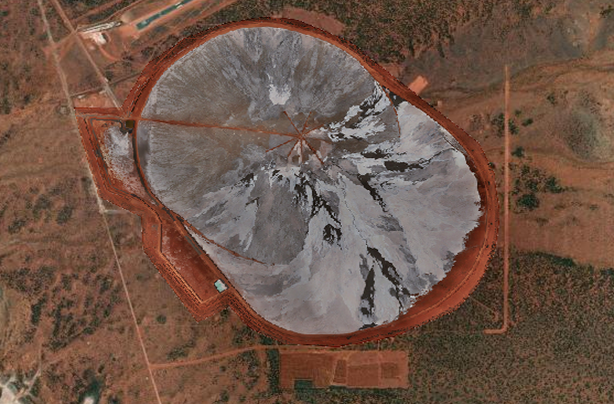
Coordinates: Lat. -29.112102°, Long. 122.454137°
Guidance Note
Refer to our guidance note.
Description and Lifecycle Design
The Central Thickened Discharge (CTD) tailings storage facility was commissioned in December 1999. Grey sandy silt tailings are deposited sub-aerially from spigots located on a central causeway to form a low angle beach sloping towards the perimeter embankment. Decant water is not stored on the tailings surface but is decanted by gravity flow to HDPE lined decant ponds located within the footprint of a larger Stormwater Storage Pond (SSP).
Stored stormwater runoff and water abstracted from a perimeter seepage management system is also pumped to the decant ponds. Water is pumped from the decant ponds and returned to the Processing Plant.
The geometry adopted for the CTD TSF embankments (starter and subsequent raises) comprised of downstream slopes of 3:1 (H:V) and upstream slopes of 2.5:1 (H:V) with a crest width of 4 m.
The original embankment zonation typically consisted of two zones:
- Zone 1 (or 1A): Low permeability material
- Zone 2 (or 2A): General embankment fill and erosion protection
The perimeter starter embankment consisted of a Zone 1 core with 0.5 m thick Zone 2 placed on the upstream and downstream slopes for erosion protection. Subsequent raises of the perimeter embankment consisted of an upstream Zone 1 material and a downstream Zone 2 or Zone 1 material. In 2017, embankments construction changed to an homogenous raise using Zone 1 material. The CTD has a compacted clay subgrade liner floor.
The embankments are constructed by an external earthmoving contractor. Zone 1 material is sourced from borrow pits adjacent to the CTD.
The CTD has a current maximum perimeter embankment height of ~ 7.5m and a maximum design embankment height of ~8.5m. The maximum height of the central causeway and tailings deposit is ~34m.
At closure, the CTD surface will be covered, regraded and rehabilitated in line with the designated post closure land use (pastoral) as outlined in the SDGM Mine Closure Plan.
AngloGold Ashanti has an internal corporate tailings management team including an accountable executive and an internal Responsible Tailings Facility Engineer (RTFE) and has appointed an external Engineer of Record (EoR) and an Independent Tailings Review Board (ITRB) at this facility to oversee and govern the design, construction, operations, maintenance, and surveillance of the facility.
SDGM CTD General Information
| Start of Operation | 1999 |
| Construction Method | Downstream low permeability embankment wall |
| Current Deposition Method | Central Thickened Discharge |
| Target Annual Production Rate | 4.1Mtpa |
| Current Tailings Volume / Tonnage | 52.99Mm3 / 94.74 Mt |
| Perimeter Embankment Crest Elevation | 406 – 410 m AHD (from west to east) |
| Spillway Elevation | 405.2 m AHD (SSP) |
| Maximum Height | 8.5m (perimeter embankment) 34m (central causeway) |
| Outer Wall Profile | 1V:3H |
Consequence Classification
| GISTM Consequence Classification | High* |
Risk Assessment
Risk assessments are conducted with a multidisciplinary team and in collaboration with the EoR. The risk assessments including the additional mitigation measures and residual risks are reviewed by the ITRB and are to be approved by the Accountable Executive.
A Failure Mode and Effects Assessment (FMEA) was undertaken for the CTD, which demonstrated that the CTD has eliminated most potential failure modes through its robust design and efficient operation. Current and residual risks associated with remaining potential failure modes are reviewed annually to identify additional mitigation measures or controls that can be adopted to further reduce the risks to ALARP.
Impact Assessment
The impact of a potential flow failure has been assessed considering the impact to human health and life, the environment, social and cultural impacts, as well as the infrastructure and economic impacts. These potential impacts have been used to inform the CTD Consequence Classification, the risk assessment consequence definition and the mitigation measures to be implemented.
Modelling of a potential failure flow path from breach of the north-west or south-west CTD embankment indicates that since the mine site accommodation, processing and mining areas are at a higher elevation and sufficiently far away from the CTD, they would not be affected by runout of water and tailings during a dam failure.
Tailings flow if it occurred would be via natural topographic lows towards Lake Carey, with limited flow volume being deposited in the lake (if the failure was associated with a flood day scenario). The tailings are geochemically consistent with the nearby orebodies from which they are derived and are non-acid forming. Environmental remediation would involve recovery of the sandy silt materials using earthmoving equipment.
Performance Reviews
AngloGold Ashanti has a comprehensive Tailings Review System which incorporates reviews from multiple levels and internal and external parties. All AngloGold Ashanti TSFs are subject to the following reviews:
- RTFE Performance Reviews – typically quarterly
- EoR reports – typically quarterly with biennial inspections and annual performance reviews
- ITRB Review – Annually
- AngloGold Ashanti Corporate Review – Annually
- Independent 3rd Party Regulatory Review – Annually
- Dam Safety Review – Typically every five years
| Reviews | Most Recent Review | Next Planned Review |
|---|---|---|
| EoR | March 2025 | June 2025 |
| ITRB | Sep 2024 | Q3 2025 |
| Regulatory | Sep 2024 | Q3 2025 |
| DSR | Aug 2023 | Q3 2028 |
AngloGold Ashanti has adopted the following ranking system for independent reviews: Priority 1 actions are classified as a material finding.
Priority 1 – A dam safety issue considered immediately dangerous to life, health or the environment, or at significant risk of regulatory enforcement.
Priority 2 – If not corrected, a concern that could result in a dam safety issue leading to injury, health impact or discontinuity of operations.
Priority 3 – Single occurrence of deficiency or non-conformance that alone would not be expected to result in dam safety issues, discontinuity of operations or regulatory intervention.
Priority 4 – A recommendation based on good practice, improvement, or risk reduction.
No material findings have been identified to date for the CTD TSF.
Environmental and Social
Environment and Social monitoring programmes form part of AngloGold Ashanti’s Health, Safety, Environment (ISO14001) and Social Communities (HSEC) management systems, which act to fulfil the environmental social management system requirements under the GISTM. These environment and social monitoring programmes are comprehensively reviewed, and mitigation measures implemented as and where required. Further information on of our environment and social monitoring programmes, and performance results can be found in AngloGold Ashanti’s Sustainability Reports.
No material findings were made in relation to the CTD.
Groundwater level and chemistry in the proximity of the CTD is monitored and managed below specified trigger levels.
An easily accessible and effective grievance mechanism has been implemented so that any formal complaints can be submitted by stakeholders and resolved.
Emergency Response and Preparedness
Sunrise Dam Gold Mine (SDGM) has no external parties or population within the region or within the flow path of a hypothetical tailings breach. The mine has a dedicated Emergency Response Team and Emergency Management and Response Plan (EMRP). The EMRP identifies potential events and incidents, defines those personnel responsible for implementation of the response, and describes procedures for notification, communication and escalation of the emergency response. Due to the remote location of the SDGM site, the site emergency response team plan all initial responses without additional support from external or public agencies.
The CTD’s emergency preparedness and response planning is a dedicated plan that is to be appended to the site wide EMRP and the facility operation, maintenance and surveillance manual.
In the event of a tailings dam related emergency, the Emergency Response Team would be the first and primary responders.
Financial Capacity
AngloGold Ashanti confirms it has adequate financial capacity to cover the estimated costs of planned closure, early closure, reclamation, and post-closure monitoring and maintenance of the TSF and its appurtenant structures.
Guidance Note
Certain statements contained in this document, other than statements of historical fact, including, without limitation, those concerning the economic outlook for the gold mining industry, expectations regarding gold prices, production, total cash costs, all-in sustaining costs, cost savings and other operating results, return on equity, productivity improvements, growth prospects and outlook of AngloGold Ashanti’s operations, individually or in the aggregate, including the achievement of project milestones, commencement and completion of commercial operations of certain of AngloGold Ashanti’s exploration and production projects and the completion of acquisitions, dispositions or joint venture transactions, AngloGold Ashanti’s liquidity and capital resources and capital expenditures, the consequences of the COVID-19 pandemic and the outcome and consequences of any potential or pending litigation or regulatory proceedings or environmental, health and safety issues, are forward-looking statements regarding AngloGold Ashanti’s financial reports, operations, economic performance and financial condition.
These forward-looking statements or forecasts are not based on historical facts, but rather reflect our current beliefs and expectations concerning future events and generally may be identified by the use of forward-looking words, phrases and expressions such as “believe”, “expect”, “aim”, “anticipate”, “intend”, “foresee”, “forecast”, “predict”, “project”, “estimate”, “likely”, “may”, “might”, “could”, “should”, “would”, “seek”, “plan”, “scheduled”, “possible”, “continue”, “potential”, “outlook”, “target” or other similar words, phrases, and expressions; provided that the absence thereof does not mean that a statement is not forward-looking. Similarly, statements that describe our objectives, plans or goals are or may be forward-looking statements.
These forward-looking statements or forecasts involve known and unknown risks, uncertainties and other factors that may cause AngloGold Ashanti’s actual results, performance, actions or achievements to differ materially from the anticipated results, performance, actions or achievements expressed or implied in these forward-looking statements. Although AngloGold Ashanti believes that the expectations reflected in such forward-looking statements and forecasts are reasonable, no assurance can be given that such expectations will prove to have been correct.
Accordingly, results, performance, actions or achievements could differ materially from those set out in the forward-looking statements as a result of, among other factors, changes in economic, social, political and market conditions, including related to inflation or international conflicts, the success of business and operating initiatives, changes in the regulatory environment and other government actions, including environmental approvals, fluctuations in gold prices and exchange rates, the outcome of pending or future litigation proceedings, any supply chain disruptions, any public health crises, pandemics or epidemics (including the COVID-19 pandemic), the failure to maintain effective internal control over financial reporting or effective disclosure controls and procedures, the inability to remediate one or more material weaknesses, or the discovery of additional material weaknesses, in the Company’s internal control over financial reporting, and other business and operational risks and challenges and other factors, including mining accidents.
For a discussion of such risk factors, refer to AngloGold Ashanti’s annual report on Form 20-F for the financial year ended 31 December 2024 filed with the United States Securities and Exchange Commission (SEC). These factors are not necessarily all of the important factors that could cause AngloGold Ashanti’s actual results, performance, actions or achievements to differ materially from those expressed in any forward-looking statements. Other unknown or unpredictable factors could also have material adverse effects on AngloGold Ashanti’s future results, performance, actions or achievements. Consequently, readers are cautioned not to place undue reliance on forward-looking statements.
AngloGold Ashanti undertakes no obligation to update publicly or release any revisions to these forward-looking statements to reflect events or circumstances after the date hereof or to reflect the occurrence of unanticipated events, except to the extent required by applicable law. All subsequent written or oral forward-looking statements attributable to AngloGold Ashanti or any person acting on its behalf are qualified by the cautionary statements herein.