![AngloGold Ashanti [logo]](https://www.anglogoldashanti.com/wp-content/uploads/2021/05/logo.svg)

June 2025
Coordinates: Lat. 6.219122°, Long. -1.665141°
Guidance Note
Refer to our guidance note.
Description and Lifecycle Design
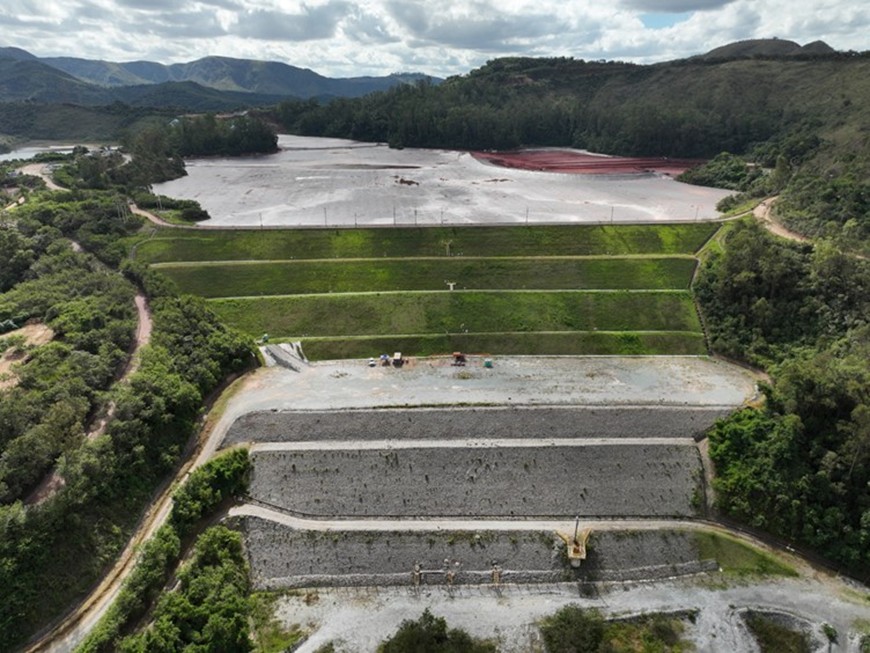
Constructed in 1986, the Calcinados TSF has a crest elevation of 863 m, a maximum height of 57m and a crest length of 315m. The TSF was constructed with two starter embankments which were subsequently raised with the coarse fraction from cyclone tailings to provide internal drainage for the dam, this was in addition to the blanket drain at the base of the TSF. Seepage collected at the toe is pumped back onto the TSF.
Previously there was a penstock inside the TSF with a horizontal outlet exiting downstream of the TSF. The penstock structure has subsequently been sealed with concrete and the outlet has been covered by the rockfill buttress. The rockfill buttress along the lower portion of the dam is composed primarily of schist rock with a relatively high fine content.
Chronology of TSF raises:
- 1985: Initial dam construction, including the construction of two starter embankments.
- 2015: Centerline raise using cyclone tailings up to elevation 860 mamsl.
- 2017: Downstream raise using compacted soil and construction of the saddle wall.
- 2020: Implementation of a buttress using waste rock.
- 2022: Decommissioning of the facility.
- 2023: Installation of an impermeable liner in the reservoir.
- 2024: Commencement of decharacterisation activities.
The saddle wall separates the Calcinados TSF from the Rapaunha TSF. It has a crest elevation of 863m (same as the Calcinados Dam), a maximum height of 6m, and slopes of 2H:1V on both the downstream and upstream sides. This TSF has a spillway that was constructed as part of the saddle wall raise carried out in 2017. This spillway overflows into the adjacent Rapaunha TSF. The basin of the TSF was lined with an HDPE liner in 2023 to minimise the ingress of rainwater during the rainy season as the TSF is not currently operational.
It is important to note that the Calcinados TSF has not received tailings slurry since 2022, and no further raises are planned for this TSF. However, as part of the decharacterisation project, filtered tailings are currently being managed within the reservoir.
Calcine TSF General Information
| Facility Name | Calcine TSF |
| Start of Operation | 1986 |
| Construction Method | Downstream cyclone wall |
| Current Deposition Method | Deposition of filtered tailings to meet the closure design. |
| Target Annual Deposition Rate | De-characterisation of the TSF in progress |
| Current Tailings Volume | 4.4 Mm3 |
| Design/License Capacity – Volume/Tonnage | 4.4 Mm3 |
| Crest Elevation | 863 mamsl |
| Spillway Elevation | 859.70 mamsl |
| Maximum Height | 57m |
| Outer Wall Profile | 1V:2H (Downstream) |
Consequence Classification
| TSF Classification | Extreme |
Risk Assessment
AngloGold Ashanti’s comprehensive risk management system uses designs and controls to eliminate risks and where there are remaining risks, these are mitigated such that the residual risk is a As Low as Reasonably Practicable (ALARP).
Risk assessments are conducted by a multi-disciplinary team in collaboration with the Engineer of Record (EoR) for each facility in line with nationally or internationally accepted best practices. The risk assessment report provides a summary of the key details of the structure, including site investigations, geotechnical parameters, foundation conditions, embankment properties, drainage system details, spillway details, monitoring criteria, and the tailings disposal plan. It also details the risk-analyses methodology (using the qualitative bowtie method), potential failure modes along with their susceptibility and consequences, and the control and mitigation measures.
As part of the risk analysis conducted in 2024, 10 risks were mapped that could in theory lead to a reduction in the dam’s structural performance, with four of these risks being classified in the ALARP (manageable) range and four in the acceptable range. For the four risks in the ALARP (manageable) range, action plans have been developed, to where possible, further reduce these risks to the acceptable range. In the Risk Assessment for the Executive Decharacterization Project of the Calcinados Dam for the construction phase, 4 risks were identified as falling within the ALARP (manageable) tolerability range. In addition, actions were recommended for acceptable risks and general recommendations to be applied in the operation and maintenance of the TSF. All of these action plans aim to reduce the probability of possible risks, as well as minimize possible impacts resulting from occurrences in the structure.
Impact Assessment
The impact of a potential flow failure has been assessed considering the impact to human health and life, the environment, social and cultural impacts, as well as the infrastructure and economic impacts. These potential impacts have been used to inform the TSF Classification and the risk assessment consequence definition and the mitigation measures to be implemented.
The impact zone covers a distance of 84.7km downstream of the Calcine TSF. The municipalities and areas affected by the impact zone and the main social information of the potential floodplain in the event of the rupture of the Calcinados TSF is shown in the tables below.
Areas affected by Impact Zone:
Calcinados TSF
| Municipalities in ZAS | Nova Lima (MG), Raposos (MG) |
| Municipalities in ZSS | Nova Lima (MG), Raposos (MG), Sabará (MG), Belo Horizonte (MG), Santa Luzia (MG) |
| Main Watercourses Impacted | Rio das Velhas, Córrego da Mina (Queiroz), Ribeirão Sabará, Ribeirão Arrudas, Ribeirão da Prata, Córrego Malheiros, Ribeirão Baronesa, Ribeirão da Mata, Rio Taquaraçu |
| Watersheds | Rio das Velhas |
| Areas with Potential for Interference | Private properties, road infrastructure (MG-030, AMG-150, MG 437, MG-262, BR-381, AMG-145 and MG-020), streets, bridges, in addition to commercial & healthcare establishments, schools, inns, police stations, museums and historical heritage referring to the district of Honório Bicalho in Nova Lima (MG), and to the urban area centers of Raposos (MG), Sabará (MG), Santa Luzia (MG) & Lagoa Santa (MG). |
Summary of the socio-territorial characterization of the impact zone
| Type of Property | Quantity |
|---|---|
| Registered properties | 2,077 |
| Residences | 1,662 |
| Building | 273 |
| Economic activity | 92 |
| Entities and public agencies | 50 |
| Total Population in ZAS | 7,451 |
| Population with mobility difficulties | 2,617 |
| Population with Special Needs | 786 |
| Number of Sensitive buildings in ZAS | 69 |
Performance Reviews
AngloGold Ashanti has a comprehensive Tailings Review System which incorporates reviews from multiple levels and internal and external parties. All AngloGold Ashanti TSFs are subject to the following reviews:
- RTFE Performance Reviews – monthly inspections
- EoR Inspections – Monthly, with two safety declarations submitted to the Brazilian National Mining Agency (ANM) in March and September of each year.
- Independent Review of the Emergency Response and Preparedness Plan (EPRP) – Annually
- ITRB Review – Annually
- AngloGold Ashanti Corporate Review – Annually
- Dam Safety Review (RPSB)– Typically every three years or when change TSF
| Reviews | Most Recent Review | Next Planned Review |
|---|---|---|
| EoR | May 2025 | Monthly – 2025 |
| ITRB | October 2024 | October 2025 |
| RPSB | May 2024 | May 2027 |
AngloGold Ashanti has adopted the following ranking system for independent reviews:
Priority 1 – A dam safety issue considered immediately dangerous to life, health or the environment, or presents a significant risk of regulatory enforcement. Requires immediate action and to be completed as soon as practically possible but certainly within 2 months
Priority 2 – If not corrected, a concern that could result in a dam safety issue leading to injury, health impact or discontinuity of operations. Requires immediate planning and completion by a date and specified by operations but as a minimum within 5-6 months
Priority 3 – Single occurrence of deficiency or non-conformance that alone would not be expected to result in dam safety issues, discontinuity of operations or regulatory intervention. Requires that measures be taken no later than a date that would prevent escalation, but no later than one year
Priority 4 – A recommendation based on good practice, improvement, or risk reduction. Recommendation towards best practices and mitigating risk associated.
No Priority 1 recommendations have been issued by the ITRB for the Calcinados TSF.
Environmental and Social
Environment and Social monitoring programmes form part of AngloGold Ashanti’s Health, Safety, Environment (ISO14001) and Social Communities (HSEC) management systems, which act to fulfill the environmental social management system requirements under the GISTM. These environment and social monitoring programmes are comprehensively reviewed, and mitigation measures implemented as and where required. Further information on of our environment and social monitoring programmes, and performance results can be found in AngloGold Ashanti’s Sustainability Reports.
There is potential for ground water seepage from TSFs and ground water conditions around all our TSFs are regularly monitored. Where groundwater impact plumes exist, their migration is modelled and managed, as necessary to avoid interaction(s) with potential receptors.
An easily accessible and effective grievance mechanism has been implemented so that any formal complaints can be submitted by stakeholders and resolved.
Emergency Response and Preparedness
Emergency preparedness and response planning (EPRP) relies on an emergency notification system that consists of remote stations equipped with sirens linked to the control room at the Queiroz plant, which scans tiltmeters located on the dam face. Manual activation of the sirens is available locally as redundancy. Mobile sirens are fitted on emergency vehicles assigned to predefined emergency routes as an additional notification measure.
The latest dam breach study was conducted in May 2022 and an EPRP training exercise, involving members of the community, was undertaken in 2025 Training exercises have included military civil organizations (police, fire) for various communities.
The escape routes and meeting points are sign posted and were developed based on the zone of influence, in which a maximum walking distance of 1,000m was considered in order to allow a quick and safe route to meeting points. The meeting point signage has information such as telephone numbers of emergency agencies, recommendations for the population, among other self-preservation information.
A copy of the Calcinados EPRP can be downloaded on the following link: BARRAGEM CALCINADOS – AngloGold Ashanti Brasil
Financial Capacity
AngloGold Ashanti confirms it has adequate financial capacity to cover the agreed share of estimated costs of planned closure, early closure, reclamation, and post-closure monitoring and maintenance of the Calcinados TSF and its appurtenant structures.
Guidance Note
Certain statements contained in this document, other than statements of historical fact, including, without limitation, those concerning the economic outlook for the gold mining industry, expectations regarding gold prices, production, total cash costs, all-in sustaining costs, cost savings and other operating results, return on equity, productivity improvements, growth prospects and outlook of AngloGold Ashanti’s operations, individually or in the aggregate, including the achievement of project milestones, commencement and completion of commercial operations of certain of AngloGold Ashanti’s exploration and production projects and the completion of acquisitions, dispositions or joint venture transactions, AngloGold Ashanti’s liquidity and capital resources and capital expenditures, the consequences of the COVID-19 pandemic and the outcome and consequences of any potential or pending litigation or regulatory proceedings or environmental, health and safety issues, are forward-looking statements regarding AngloGold Ashanti’s financial reports, operations, economic performance and financial condition.
These forward-looking statements or forecasts are not based on historical facts, but rather reflect our current beliefs and expectations concerning future events and generally may be identified by the use of forward-looking words, phrases and expressions such as “believe”, “expect”, “aim”, “anticipate”, “intend”, “foresee”, “forecast”, “predict”, “project”, “estimate”, “likely”, “may”, “might”, “could”, “should”, “would”, “seek”, “plan”, “scheduled”, “possible”, “continue”, “potential”, “outlook”, “target” or other similar words, phrases, and expressions; provided that the absence thereof does not mean that a statement is not forward-looking. Similarly, statements that describe our objectives, plans or goals are or may be forward-looking statements.
These forward-looking statements or forecasts involve known and unknown risks, uncertainties and other factors that may cause AngloGold Ashanti’s actual results, performance, actions or achievements to differ materially from the anticipated results, performance, actions or achievements expressed or implied in these forward-looking statements. Although AngloGold Ashanti believes that the expectations reflected in such forward-looking statements and forecasts are reasonable, no assurance can be given that such expectations will prove to have been correct.
Accordingly, results, performance, actions or achievements could differ materially from those set out in the forward-looking statements as a result of, among other factors, changes in economic, social, political and market conditions, including related to inflation or international conflicts, the success of business and operating initiatives, changes in the regulatory environment and other government actions, including environmental approvals, fluctuations in gold prices and exchange rates, the outcome of pending or future litigation proceedings, any supply chain disruptions, any public health crises, pandemics or epidemics (including the COVID-19 pandemic), the failure to maintain effective internal control over financial reporting or effective disclosure controls and procedures, the inability to remediate one or more material weaknesses, or the discovery of additional material weaknesses, in the Company’s internal control over financial reporting, and other business and operational risks and challenges and other factors, including mining accidents.
For a discussion of such risk factors, refer to AngloGold Ashanti’s annual report on Form 20-F for the financial year ended 31 December 2024 filed with the United States Securities and Exchange Commission (SEC). These factors are not necessarily all of the important factors that could cause AngloGold Ashanti’s actual results, performance, actions or achievements to differ materially from those expressed in any forward-looking statements. Other unknown or unpredictable factors could also have material adverse effects on AngloGold Ashanti’s future results, performance, actions or achievements. Consequently, readers are cautioned not to place undue reliance on forward-looking statements.
AngloGold Ashanti undertakes no obligation to update publicly or release any revisions to these forward-looking statements to reflect events or circumstances after the date hereof or to reflect the occurrence of unanticipated events, except to the extent required by applicable law. All subsequent written or oral forward-looking statements attributable to AngloGold Ashanti or any person acting on its behalf are qualified by the cautionary statements herein.